Water off first, photograph second, and the replacement fitting usually arrives with the plumber rather than after him.
Online Now!·--:--
The order for a burst is not negotiable. Get the water off at the meter first, because everything about what this costs is decided between the failure and the tap closing.
Once it is off, take a photograph. Not for the record and not for an insurer, but because it is the single most practical thing you can do to make this a one-visit job. A picture of the failed section shows the pipe material, the type of fitting and roughly its age, and those three things decide what has to come with us.
It matters here specifically because there is nothing in Cheltenham to fetch. No hardware store, no plumbing supplier. Whatever a repair needs either arrives on the van or the job takes a second visit, and the second visit is the one that costs you a morning.
The same is true of the far less dramatic version. A dripping tap is not a universal object: spindles and seats vary by type and brand. A photo from the front and from above regularly means the correct parts are in the van before anybody leaves.

Shut the supply off, then take one picture. We will stay on the line while you do both.
Between the failure and the tap closing is where the damage happens.
Know where your meter and stop tap are before you need them.
Pipe material, fitting type and roughly the age, in one image.
None of those three survive being described down a phone.
Spindles and seats vary by type and brand, and there is no generic one.
A photo front and above usually settles it.
Everything closed, and a creeping smallest dial means water is genuinely leaving.
A still dial points somewhere else entirely.
Not because of what we charge, but because of your morning.
Thirty seconds of photographs is the cheapest way to avoid it.
Fixed price agreed before anything starts. These are indicative 2026 ranges.
Water stopped and the situation stabilised, at any hour.
Fittings included, and the right ones if you sent a photo.
Acoustic, pressure and thermal, with nothing opened to find it.
Depending on the pipe, the material and how it has to be reached.
Where it was, what failed, and what we did about it.

We stay on the phone for the first and ask for the second, because between them they shape the entire visit.

From what the photograph showed, rather than from what we hope is on the shelf in the van.

Where the leak is concealed: acoustic, pressure and thermal, until it is a point rather than an area.

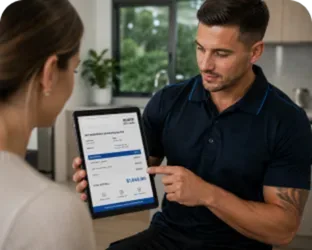
What failed, where, and what it took, at the figure agreed before we started.
Shut it off at the meter and ring. A licensed plumber can be heading toward you while you are still on the call.
Call 1300 381 569
Turn the water off at the meter before anything else, then ring. How much a burst costs is almost entirely decided by how long the supply stayed on, and nothing else in the first five minutes matters as much.
Once the water is off, yes, and it is genuinely useful rather than a formality. A photograph of the failed section shows the pipe material, the type of fitting and roughly its age all at once. Those three things decide what needs to come with us, and there is nowhere in Cheltenham to collect something we did not bring.
Same answer and it matters more than people expect. Tapware is not universal. A photograph of the tap, from the front and from above, tells us the type and frequently the brand, and whether the spindle and seat we would bring are the right ones.
Less directly, but the surrounding detail still helps. A photo of the wall or ceiling where it is showing, and of the meter with everything closed, tells us more than a description of either.
Close every tap and appliance, then watch the smallest dial on the water meter for a few minutes. If it is creeping, water is leaving somewhere on your side. If it is still, whatever you are seeing has another explanation. It costs nothing and it takes five minutes.
Acoustic listening, pressure testing and thermal imaging, chosen to suit what is leaking and where it runs. None of them require opening a wall to have a look first.
Emergency isolation and make-safe is $200 to $450. Locating a concealed leak is $250 to $600. A burst repair is $300 to $900. A tap or valve repair is $150 to $350, fittings included.
Shut the water off, then send one photograph of whatever has failed. Those two actions do more for the outcome than anything else you could do.
Made safe, located, and repaired with the right part rather than the nearest one.
Online Now!·--:--